With the beginning of the fall season, many people start to use their stoves more than they did over the summer months. Some people need to complete preparations of fruits and vegetables for canning, dehydrating, and freezing or decide to practice baking and cooking for upcoming holiday parties. A lot of parents and children also increase their time in the kitchen to make snacks and dishes for school and extracurricular events. The majority of these bakers and cooks turn to the same source, the stove’s bottom drawer located under the oven, to retrieve cake pans, cookie sheets, muffin tins, and other metal cookware commonly used more this time of year.
Yet, this drawer wasn’t designed to strictly serve this function when appliance manufacturers first released bottom drawer stoves to the public. Instead, these models typically had a “warming drawer” to keep dishes of various foods warm before a meal or while serving different courses. With a stove that features a warming drawer, a cook doesn’t have to reheat food in the oven or microwave. They simply use a button, knob, or slide to select the warming drawer option, place the food in the drawer in heat-safe dishes that aren’t made of paper or plastic, and then close the drawer. The stove maintains food temperature at levels between at least 140 and 190 degrees Fahrenheit and as high as 240 degrees. Many models offer a timer that allows a user to preset the amount of time that they want the warming drawer to maintain temps and an automatic shutoff in the event that they forget to turn off the warming function. Manufacturers also produce bottom drawer stoves that feature deep, non-warming drawers designed to store cookware and keep certain types of pot and pan materials like cast iron from rusting. Lastly, stoves exist that have a broiler bottom drawer and an included broiler pan that cook foods at higher temperatures or brown the top of roast various foods. Normally, these broiler-style models use gas that can also reproduce the grilling effect indoors via flames located above instead of below the food.
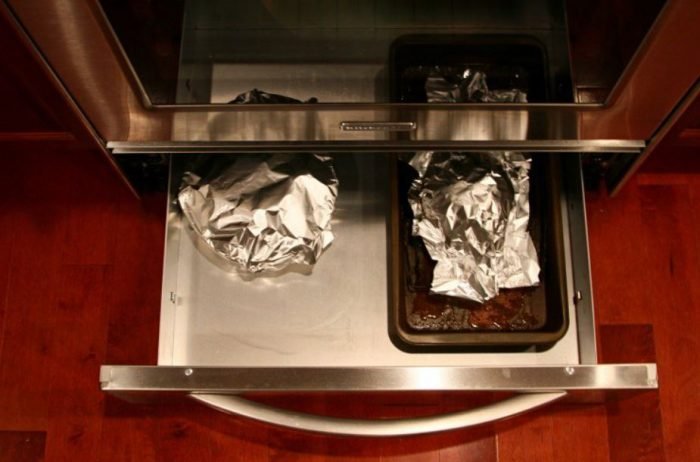
Homeowners and renters can easily determine if they have a stove that features a warming drawer by looking for a button, knob, or slide labeled with the words “warming drawer.” They can also typically find a warning label that explains that the drawer keeps food warm at “serving temperature.” The label notes that they must insert the food when it’s hot to prevent rapid bacterial growth that happens when food temperature drops below 140 degrees Fahrenheit. Given that many people don’t know about the warming drawer and rely on keeping food warm in the oven or reheating it in a microwave, many stove manufacturers have decreased the production and distribution of warming drawer stoves and increased the price of these unique appliances. People shopping for a new stove should always ask a sales representative about the possible inclusion of a warming drawer with at least three warming settings. Some newer, smart models allow a user to customize drawer heat and humidity levels. Consumers can also find models that turn the warming drawer into the equivalent of a slow cooker or bread proofer. These models usually feature a thermostat with sensors that monitor and help manage internal heat and moisture levels.
