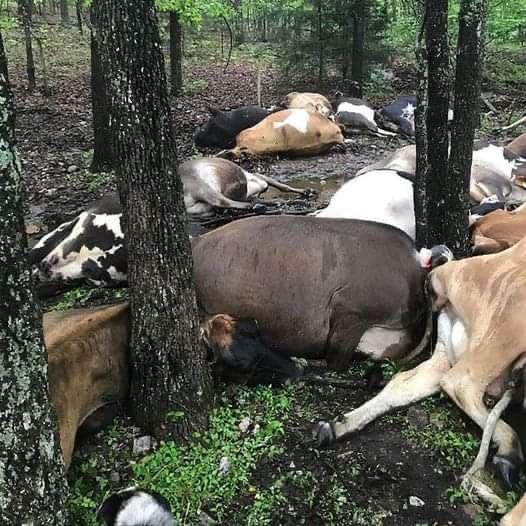
The odd crack of thunder and flash of lightning is to be expected at this time of year in Missouri.
Recent bad weather and flooding have wreaked havoc on the region.
After feeding the dairy cows on a Saturday morning, Springfield farmer Jared Blackwelder and his wife Misty heard loud crashes and didn’t give it much thought.
However, as Blackwelder returned to the pasture to collect the cows for the evening milking, he came upon a heartbreaking sight: his 32 dairy cows piled on top of each other, dead on the mulch.

“He went out to bring the cows in and that’s when he found them,” Stan Coday, president of the Wright County Missouri Farm Bureau, told CBS News. “It’s a common occurrence. It does happen. The thing that made this the worst was just the sheer number of cows that were affected.”
Coday was advised by a local vet who conducted the inspection that lightning was indeed the cause of death for the cows.
It’s possible that the cows took shelter behind the trees together as the storm raged overhead.
“You’re at the mercy of mother nature,” Coday said, adding that he himself lost a cow to lightning several years ago.
Coday stated that such a loss is incredibly difficult, even though farmers realize the risk.
“It’s not like they are pets. But the ones I’m milking, I’ve raised every one of them,” Blackwelder told the Springfield News-Leader. “Dairy cattle are a little different because you mess with them twice a day. It knocks you hard.”
It’s a monetary catastrophe, too.
According to the News-Leader, Blackwelder said he had insurance but is unsure if it will cover his losses.
He puts the value of each certified organic cow at $2,000 and $2,500, for a grand total loss of almost $60,000.
“Most producers don’t carry insurance,” Coday said. “If you lose a cow you’ve lost everything.”
Coday, who breeds beef cows, wants to clarify that meat from Blackwelder’s animals could not be recovered in response to queries from local neighbors.
“Those animals are damaged and of course they had been there for a few hours when he found them,” he said. “In processing an animal, there’s a process that needs to be gone through. They wouldn’t have been fit for human consumption.”
Coday also noted that most farmers in Missouri do not have a dedicated cow barn due to the state’s milder weather.
