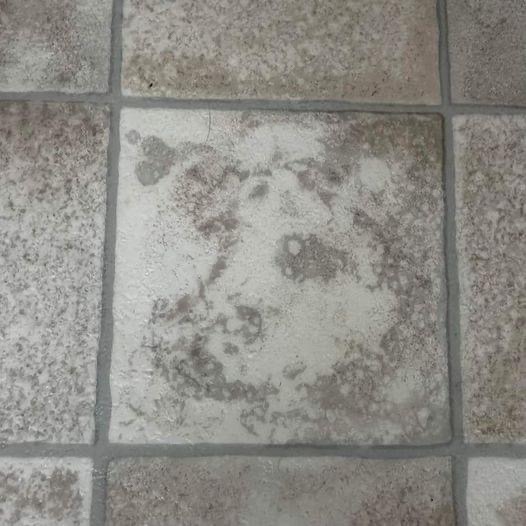
In psychology and visual perception, there’s a captivating phenomenon where we see familiar patterns, especially faces, in random objects or textures. This quirk, known as pareidolia, is perfectly illustrated in the image above. What initially seems like an ordinary tile floor reveals something more intriguing—a faint face—upon closer inspection.
What is Pareidolia?
Pareidolia is when the brain interprets random stimuli—like shapes, patterns, or sounds—as something significant, often a face or figure. This explains why we might see animals in clouds, faces in rock formations, or, in this case, a visage in a worn floor
Our brains are wired to recognize faces, an evolutionary trait that helped us identify friends, foes, and other beings from afar. This facial recognition ability is so strong that even with only a vague resemblance, our brains fill in the gaps, making us see faces where none exist.
The Tile Face: A Closer Look
In the image, the rough texture of the tile outlines a face with eyes, a nose, and a mouth. The “eyes” might be darker spots, the “nose” a central smudge, and the “mouth” a faint curve. The face appears ghostly, like a hidden character peering out, waiting to be noticed.
This instance of pareidolia transforms an ordinary object, like a floor tile, into something mysterious and artistic. For some, this face might evoke wonder or even a bit of eeriness, as if the inanimate world around us is coming to life in unexpected ways.
Why Do We See Faces?
Seeing faces in inanimate objects is more common than you might think and isn’t limited to tiles or wall patterns. This tendency stems from our evolutionary need for social connection and survival. Quickly identifying faces was crucial for early humans in recognizing allies and detecting threats. Over time, our brains became adept at picking up even the slightest facial cues, sometimes to the point of over-interpretation.
Scientists suggest that this ability to see faces has likely played a role in reading emotions, understanding social interactions, and even creating art. It highlights the brain’s capacity to find meaning in the world, even when that meaning is purely in our minds.
The Artistic Side of Pareidolia
Beyond its scientific roots, pareidolia has an artistic side. Artists have long been inspired by finding hidden images in the world around us. This art form encourages viewers to look beyond the obvious and find beauty in the unexpected.
The tile face in the image could be seen as natural art—an accidental masterpiece shaped by time, wear, and our imagination. It’s a reminder that art can be found anywhere, even in the most mundane places, if we take a moment to see it.
Conclusion
The next time you’re walking across a tiled floor, staring at a cloud-filled sky, or gazing at a textured wall, take a closer look. You might find a face staring back at you. Pareidolia is more than a mind trick; it reveals how our brains interpret the world and find wonder in the ordinary. Whether it’s a face on a tile or a figure in the shadows, these moments of recognition are small reminders of the magic hidden in everyday
