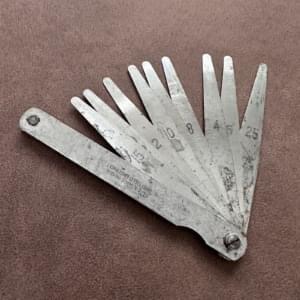
History of the Feeler Gauge Tool
The feeler gauge tool, a staple in mechanical and engineering fields, has a history dating back to the early 20th century. Developed as precision measurement became essential in the industrial age, the feeler gauge allowed for accurate assessment of gaps and clearances between mechanical parts. Its invention marked a significant advancement in the maintenance and assembly of machinery, ensuring that components fit together with the necessary precision.
Usage of the Feeler Gauge Tool
Precision Measurement
Feeler gauges consist of a set of thin metal blades, each with a different thickness, calibrated to measure small gaps. These tools are indispensable in various applications:
- Automotive Industry: Mechanics use feeler gauges to set spark plug gaps, valve clearances, and measure gaps between engine components.
- Manufacturing: In manufacturing, feeler gauges help ensure that machine parts fit together correctly, maintaining product quality and operational efficiency.
- Engineering: Engineers use feeler gauges in design and maintenance tasks, verifying the accuracy of assembled parts and machinery.
Versatility and Ease of Use
The feeler gauge’s simple design makes it versatile and easy to use. By selecting a blade of the appropriate thickness and inserting it into a gap, users can quickly and accurately measure the clearance. This simplicity, combined with its reliability, has made the feeler gauge a go-to tool in many precision-based industries.
Legacy of the Vintage Feeler Gauge Tool
Influence on Modern Tools
The legacy of the vintage feeler gauge tool is evident in modern precision measurement instruments. While digital and electronic gauges have become more prevalent, the fundamental principle of measuring gaps with thin blades remains unchanged. The feeler gauge’s influence can be seen in the design and function of contemporary tools, which strive to offer the same reliability and accuracy.
Collector’s Item
Today, vintage feeler gauges are prized by collectors and enthusiasts of antique tools. These items are valued for their craftsmanship, durability, and historical significance. Collectors often seek out well-preserved sets, appreciating the ingenuity and practicality of early 20th-century engineering tools.
Educational Tool
Vintage feeler gauges also serve as educational tools, providing insight into the evolution of precision measurement. They are used in technical schools and training programs to teach students about the fundamentals of mechanical measurement and the importance of accuracy in engineering.
The vintage feeler gauge tool has played a crucial role in the history of precision measurement. Its use in various industries, from automotive to manufacturing, has ensured the accurate assembly and maintenance of machinery. Today, it continues to influence modern tools and is valued by collectors and educators alike. The legacy of the feeler gauge reminds us of the importance of precision and the enduring impact of simple yet effective engineering solutions.
