The Arctic ice is in serious trouble, with scientists warning that it could face a significant decline within a decade. Recent data from NASA’s satellite observations reveal that the Arctic experienced its sixth-lowest minimum ice extent on record, while the Antarctic saw its smallest maximum ice coverage ever recorded. This worrying trend, which has been ongoing for years, seems to be getting worse.
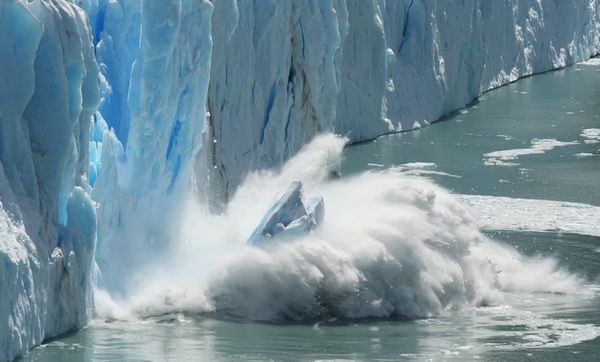
Since NASA started monitoring the Arctic sea ice in 1978, there has been a steady decrease. And projections suggest that if this trend continues, the Arctic could potentially be ice-free in September by the 2020s or 2030s. But what exactly does “ice-free” mean? It doesn’t mean a complete absence of ice, but rather having less than a million square kilometers of ice coverage.
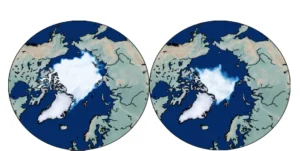
Even during the minimum ice extent observed in 2023, the Arctic sea ice covered a massive 1.63 million square miles or 4.23 million square kilometers. However, by the 2030s, it is estimated that the summer ice in the Arctic could shrink to about 24 percent of its 2023 size, regardless of different emission scenarios.
Scientists predict that this decline will continue, with ice-free conditions becoming more common in the Arctic by 2067, extending beyond just September to include August and October. However, there is hope. The reduction of greenhouse gas emissions could delay this milestone. Arctic ice melting is highly sensitive to fluctuations in carbon emissions, and reducing these emissions could help prevent prolonged ice-free periods.

A study published in Nature Reviews Earth & Environment highlights the significant impact of these changes. Alexandra Jahn, the lead author and an associate professor at CU Boulder’s Institute of Arctic and Alpine Research, emphasizes the urgency of emission reduction efforts. Even in the face of inevitable ice-free conditions, minimizing emissions is crucial to prevent prolonged ice-free periods.
These projections are based on comprehensive analyses that combine various research findings, showcasing the significant consequences, especially for wildlife that relies on sea ice. Polar bears, for example, face increasing challenges as their habitat shrinks.
The diminishing Arctic ice also opens up new shipping routes, potentially benefiting commercial interests, but it presents new challenges for marine mammals like blue whales.
Furthermore, the melting Arctic ice intensifies global warming by reducing the earth’s albedo effect. With less ice cover, there is a smaller reflective surface to bounce sunlight back into space, which accelerates melting and amplifies oceanic heat absorption. This feedback loop increases the frequency and severity of heatwaves, perpetuating a cycle of warming and melting.
Despite these alarming projections, there is hope in the Arctic’s ability to respond to climate change. Unlike long-term geological processes such as glacier formation, Arctic sea ice can regenerate relatively quickly if emissions are reduced. This highlights the importance of swift action to mitigate climate change and protect the Arctic’s delicate ecological balance. The time to act is now.
