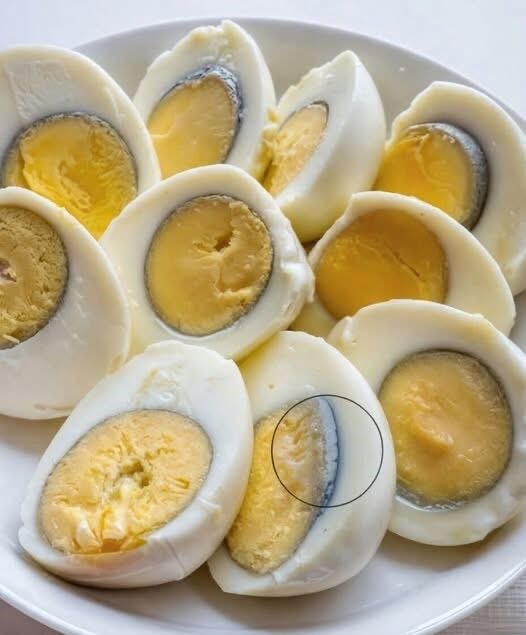
A green or gray ring around hard-boiled eggs is one of those small kitchen surprises that can make an otherwise simple cooking task feel slightly frustrating, especially because the eggs are still perfectly safe to eat even when they look “wrong.” This discoloration is not a sign of spoilage or poor-quality eggs, but rather the result of a predictable chemical reaction that happens when heat is applied for too long or too aggressively. Inside every egg, there are naturally occurring compounds that normally remain stable when cooked properly, but under excessive heat, they begin to interact in ways that change the egg’s appearance. Specifically, sulfur compounds in the egg white can react with iron present in the yolk, forming a compound called iron sulfide, which creates the greenish or gray ring. This reaction is completely harmless from a food safety perspective, but it does affect visual appeal and can also signal that the yolk has become drier or more chalky than intended. Understanding this process helps remove confusion and allows home cooks to approach egg boiling with more confidence, knowing that the issue is not failure but simply technique and temperature control. When viewed this way, the green ring becomes less of a mistake and more of a helpful indicator that can guide better cooking habits in the future.
The science behind this reaction is actually quite straightforward once broken down, and it begins with the natural composition of an egg. The yolk contains iron, while the egg white contains proteins that include sulfur-containing amino acids. Under normal cooking conditions, these elements remain separated and stable, producing the familiar bright yellow yolk and firm white that most people expect. However, when eggs are exposed to high temperatures for too long, the heat causes the sulfur compounds in the egg white to break down and release hydrogen sulfide gas. This gas then migrates toward the yolk, where it encounters iron and forms iron sulfide at the boundary between the two regions. That thin layer of iron sulfide is what appears as the green or gray ring. The longer and more intense the heat exposure, the more pronounced this reaction becomes. This is why eggs that are boiled vigorously for extended periods are far more likely to show discoloration than eggs that are gently cooked and promptly cooled. Importantly, this reaction does not alter the safety of the egg, only its appearance and, to a lesser extent, its texture.
Cooking technique plays a major role in preventing this reaction, and small adjustments can make a significant difference in the final result. One of the most common mistakes is maintaining a constant rolling boil throughout the entire cooking process. While this may seem efficient, it actually exposes the eggs to unnecessary heat stress, increasing the likelihood of sulfur release and iron sulfide formation. A more effective method is to bring the water to a boil first, then reduce the heat to a gentle simmer once the eggs are added. This softer cooking environment allows the eggs to cook evenly without excessive agitation or temperature spikes. Timing is also critical, as overcooking even by a few minutes can push the reaction forward. Depending on egg size, a controlled simmer for roughly nine to twelve minutes is typically sufficient to fully set both the whites and yolks while minimizing discoloration risk. This balance between heat and time is what separates perfectly cooked eggs from those with green-ringed yolks, and it highlights how sensitive eggs are to thermal conditions despite their simple appearance.
Equally important as the cooking process itself is what happens immediately after the eggs are removed from heat. Many people overlook this step, but it is essential in preventing continued cooking and chemical reaction. Even after being taken out of hot water, eggs retain internal heat that continues to cook the yolk, a process known as carryover cooking. If not stopped quickly, this residual heat can extend the conditions that promote iron sulfide formation. To prevent this, eggs should be transferred directly into an ice bath or placed under very cold running water as soon as they are finished cooking. Rapid cooling halts the internal cooking process almost immediately, preserving the yolk’s natural color and texture. It also helps the egg white contract slightly, which can make peeling easier and reduce surface damage. Allowing eggs to cool slowly at room temperature, on the other hand, gives more time for the sulfur-iron reaction to develop, increasing the likelihood of discoloration. This simple step is often the difference between consistently well-cooked eggs and unpredictable results.
Beyond heat and cooling, other subtle factors also influence the final appearance and quality of hard-boiled eggs. One of these is the age of the egg itself. Fresh eggs tend to have tighter internal structures, which makes them more difficult to peel but does not directly cause the green ring. However, slightly older eggs often perform better in boiling because their internal pH changes over time, weakening the bond between the egg white and the shell membrane. This makes peeling easier and reduces surface damage that can sometimes affect appearance. Storage conditions after cooking also matter, as properly chilled eggs maintain better texture and color stability. Refrigeration slows down any residual chemical activity and preserves freshness for several days. While none of these factors alone cause the green ring, they all contribute to the overall quality of the final product, showing how multiple small details work together in something as seemingly simple as boiling an egg.
Ultimately, the green ring around hard-boiled eggs is a clear example of how everyday cooking is influenced by basic chemistry, even when we are not actively thinking about it. It is not a flaw in the egg or a sign of poor quality, but rather a natural result of heat interacting with the egg’s internal structure. By controlling temperature more carefully, reducing cooking intensity, and cooling eggs rapidly after boiling, this reaction can be almost completely eliminated. What remains is a simple, reliable food that looks as good as it tastes, with bright yellow yolks and clean whites that are easy to prepare and enjoyable to eat. Understanding why the green ring forms transforms what might seem like a cooking mistake into a useful lesson about heat control and timing. In the end, mastering hard-boiled eggs is less about complexity and more about attention to detail, showing how even the smallest adjustments in process can lead to consistently better results in the kitchen.
